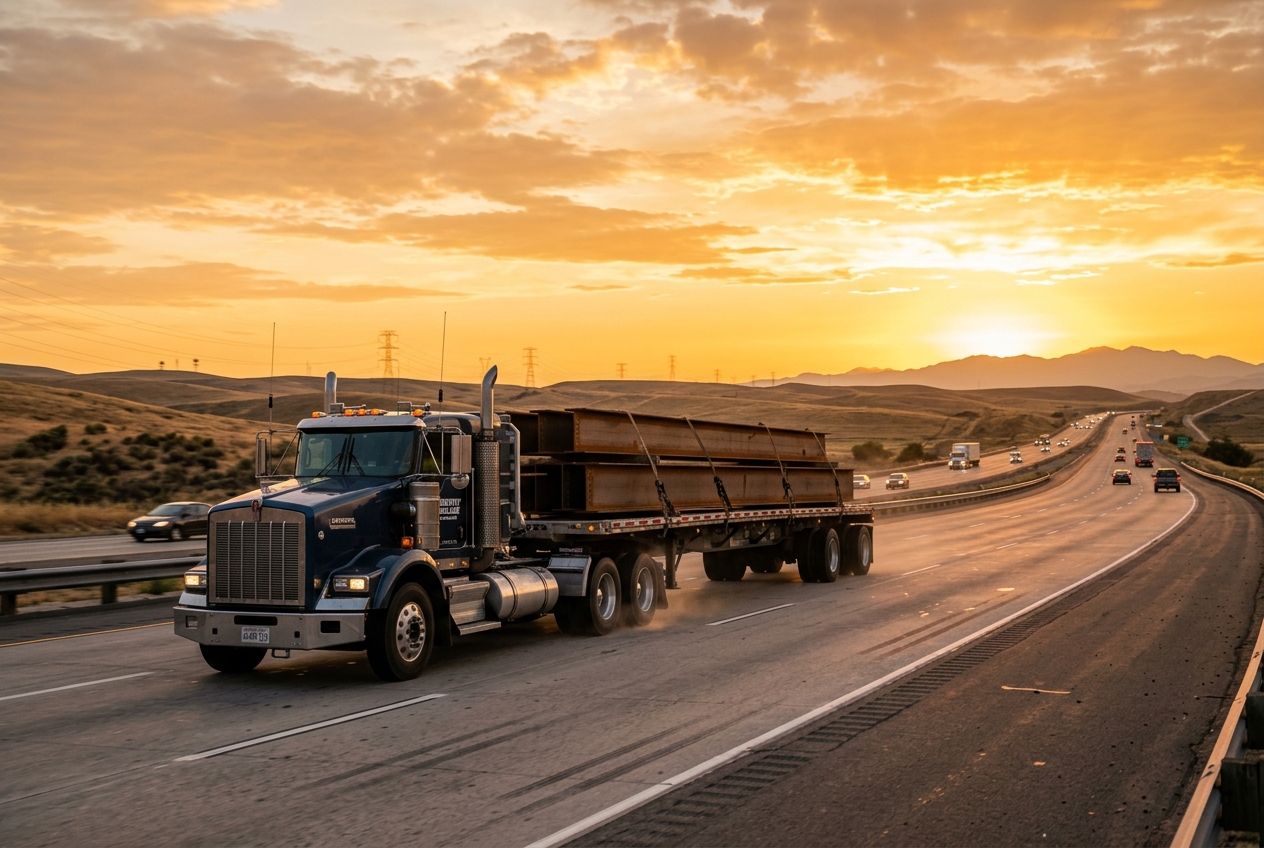
You have your CDL-A. Now comes the choice that shapes everything: what trailer type do you want to pull? Dry van, flatbed, and reefer are the three main options — and if you're choosing between flatbed and reefer, you're picking between the top two earners. Here's what actually matters.
The Pay Gap Is Real — And Bigger Than Most Think
In 2026, flatbed loads average around $4.50 per mile on the spot market — higher than reefer's average of $3.75/mi and well above dry van's $3.50/mi baseline. That gap compounds fast. On a typical 2,500-mile week, a flatbed lease driver grosses roughly $9,900 before expenses versus $8,250 for reefer and $7,700 for dry van.
Quick Numbers
Flatbed: avg $4.50/mi · Reefer: avg $3.75/mi · Dry Van: avg $3.50/mi. All figures are gross before fuel, insurance, and truck expenses.
Why Flatbed Pays More
Flatbed freight commands a premium because it requires extra work: tarping, strapping, securing, and often working with heavier or awkward cargo like steel, lumber, construction materials, and industrial equipment. Most flatbed drivers spend 30–60 minutes per load on securement alone. That labor premium shows up in the rate.
- Tarping and strapping adds physical labor most drivers don't want
- Loads often require escort vehicles, oversized permits, or special equipment
- Weather exposure — you're working outdoors on a flatbed deck in all conditions
- Greater load variety means no autopilot — every stop is different
Why Reefer Has Its Own Advantages
Reefer (refrigerated trailer) doesn't pay quite as much per mile, but it offers consistency that flatbed can't match. Temperature-sensitive freight — groceries, pharmaceuticals, produce — ships year-round with steady demand. Reefer drivers don't tarp loads, and while they deal with the complexity of monitoring trailer temperature, the loading and unloading process is generally simpler.
- Year-round steady freight with no seasonal slowdowns
- No tarping or strapping — cleaner, faster loading
- High-demand accounts: Kroger, Walmart grocery, pharmaceutical shippers
- Reefer endorsement adds value to your CDL profile
For Company Drivers: The CPM Difference
If you're running as a company driver (not lease or owner-op), your equipment choice still affects your rate. At Hylas Companion, company flatbed drivers earn 90¢ CPM — versus 87¢ for reefer and 85¢ for dry van. On a 2,500-mile week: flatbed = $2,250, reefer = $2,175, dry van = $2,125. The flatbed premium as a company driver is smaller but still real — and you carry zero truck expenses either way.
| Equipment | Company CPM | 2,500 mi / week | Annual (50 wks) |
|---|---|---|---|
| Flatbed | 90¢ | $2,250 | $112,500 |
| Reefer | 87¢ | $2,175 | $108,750 |
| Dry Van | 85¢ | $2,125 | $106,250 |
Which Should You Choose?
If maximum earnings matter most and you don't mind physical work in all weather, flatbed wins on CPM every time. If you prefer consistency, cleaner loads, and year-round predictable freight — reefer is the smart play. New CDL-A holders sometimes start on dry van before moving to reefer or flatbed as they build experience. There's no wrong answer — just match the trailer to your lifestyle.
At Hylas Companion we run all three trailer types with dedicated accounts and weekly pay. Talk to our team to find the right lane for you.