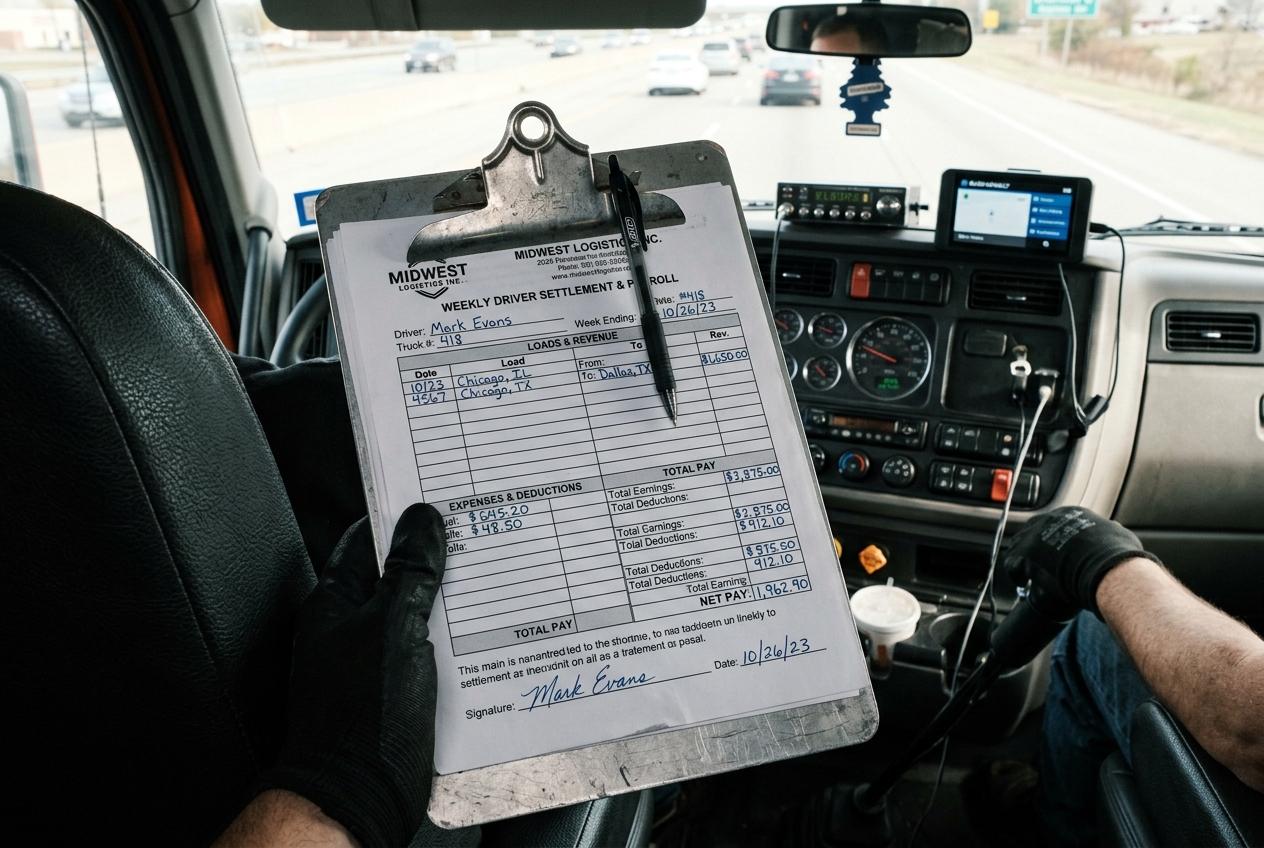
A trucking settlement sheet is your weekly financial report — and most drivers don't read it carefully enough. Errors happen. Charges slip in. Understanding every line is how you protect your money and catch problems before they compound into a bigger dispute.
What a Settlement Sheet Is (and Isn't)
A settlement sheet (also called a settlement statement or driver settlement) is issued weekly by your carrier. It's the full accounting of everything you earned and everything that was deducted from your pay. For company drivers, it's simpler — mostly just miles × CPM plus any accessorials. For lease purchase drivers, it's far more complex — every expense flows through the settlement before you see net pay.
Section 1: Gross Revenue
The top of your settlement shows gross revenue — the total your loads generated before anything comes out. For company drivers this is miles × CPM. For lease drivers it's the sum of all loads × your percentage (e.g., 88% × $4.50/mi × miles). Verify this number against your load confirmations. If you have rate confirmations from dispatch, compare them. Gross should match what you were dispatched on.
Line Items to Verify in Gross
Loaded miles (match your trip sheets), percentage rate (should match your lease agreement), accessorial pay (layover, detention, extra stops), and fuel surcharge portion if applicable.
Section 2: Fuel Advances
If you used a carrier fuel card or took a cash advance at a fuel stop, that amount appears as a deduction here. Fuel advances are not interest-bearing deductions — they're simply money you already spent that the carrier fronted. Check: does the fuel amount on your settlement match your fuel receipts? Fuel card errors (wrong truck number, double charges) happen more than you'd think.
Section 3: Fixed Weekly Deductions
This section lists the recurring charges that come out every week regardless of miles run. On a Hylas Companion lease program, fixed deductions include:
- Truck payment — $600–$800/week (verify it matches your lease agreement exactly)
- Trailer lease — $300/week
- Cargo insurance — $250/week
- Physical damage insurance — $220–$280/week
- ELD (electronic logging device) — $115/week
- Direct deposit fee — $15/week
- Roadside assistance (if enrolled) — $50/week
Section 4: Variable Deductions
Variable deductions change week to week based on miles and events. The most common:
- Maintenance fund contribution — $0.10/mi × miles driven
- Escrow contribution — $200/week (first 10 weeks only, then stops)
- Scale ticket fees — charged if you were overweight and required to purchase scale tickets
- Lumper reimbursements — if carrier advanced you lumper pay
- Permit fees — for oversized loads (flatbed specialty)
- Drug test or physical fees — if carrier deducted DOT testing cost
Section 5: Net Pay
Net pay = Gross Revenue − Fuel − Fixed Deductions − Variable Deductions. This is what hits your bank account. Verify the math yourself. Carriers run automated payroll systems and errors do occur — especially on deduction line items that have caps (like escrow, which should stop after week 10) or one-time fees that sometimes repeat incorrectly.
| Line Item | Type | Typical Amount | Should Stop? |
|---|---|---|---|
| Gross Revenue | Credit | $9,900 (2,500 mi) | — |
| Fuel | Deduction | ~$2,143 | No |
| Truck Note | Fixed | $700/wk | No |
| Cargo Insurance | Fixed | $250/wk | No |
| Physical Damage | Fixed | $250/wk | No |
| ELD | Fixed | $115/wk | No |
| Escrow | Variable | $200/wk | After wk 10 |
| Maintenance Fund | Variable | $250 (0.10/mi) | No |
| Net Pay | Result | ~$5,577 | — |
Common Settlement Errors to Watch For
- Escrow still being deducted after week 10 — save your early settlements to track this
- Fuel charges for another truck's card swipe — verify gallons and location
- Wrong CPM applied — especially after a pay raise or equipment change
- Accessorials missing — detention pay, layover, extra stop pay not credited
- Maintenance fund charged at wrong rate — should be exactly $0.10/mi
- Insurance rate increase not communicated — compare week-over-week
What to Do If You Find an Error
Contact your settlements department within 5 business days with the specific line item, the settlement week, and the documentation supporting the correction (fuel receipt, rate confirmation, lease agreement). Most legitimate errors are corrected in the following week's settlement. Keep printed or PDF copies of every settlement — you'll need them if there's a dispute, when you do taxes, or when you're comparing job offers.
At Hylas Companion, settlement questions go directly to our settlements team available Monday–Friday. Transparent, itemized settlements are a baseline expectation we hold our operations team to.